Ongoing:
Project: The Recreation of the 16th Century Feather Mosaics, Collaborator: Megan Meyer
This project focuses on recreating Aztec feather mosaics in the 16th-century style. Began as an art form used extensively for ceremonial purposes, feather mosaics were deeply entwined with the indigenous religion. After the Spanish invasion, however, these mosaics began to adopt Christian imageries as the original subjects were banned. As a result, this hybridity led to a brief yet illuminative art form that bridged the cultures from two continents.
For this project, we aim to recreate a feather mosaic following authentic procedures. With an original and age-appropriate design of the Annunciation, we interpret the subject in two forms: a feather mosaic consistent with the style of early New Spain, and an oil painting in the concurrent Spanish Baroque style as a comparison. While the images are executed with the same composition and dimension, the stark differences emphasize both the adaptation and transformation of the art in New Spain.
This interdisciplinary project also traces the ultimate origin of feather mosaics back to the birds of the Americas. As the refractive, transparent, and iridescent properties of feathers provide unique characteristics to this medium, they also play important roles in the life of their hosts. At the same time, because many bird species were hunted, kept, and endangered for their feathers throughout this practice, thus our project also has an emphasis on the diversity and conversation of American birds.
Lean more at https://feathermosaics.com.
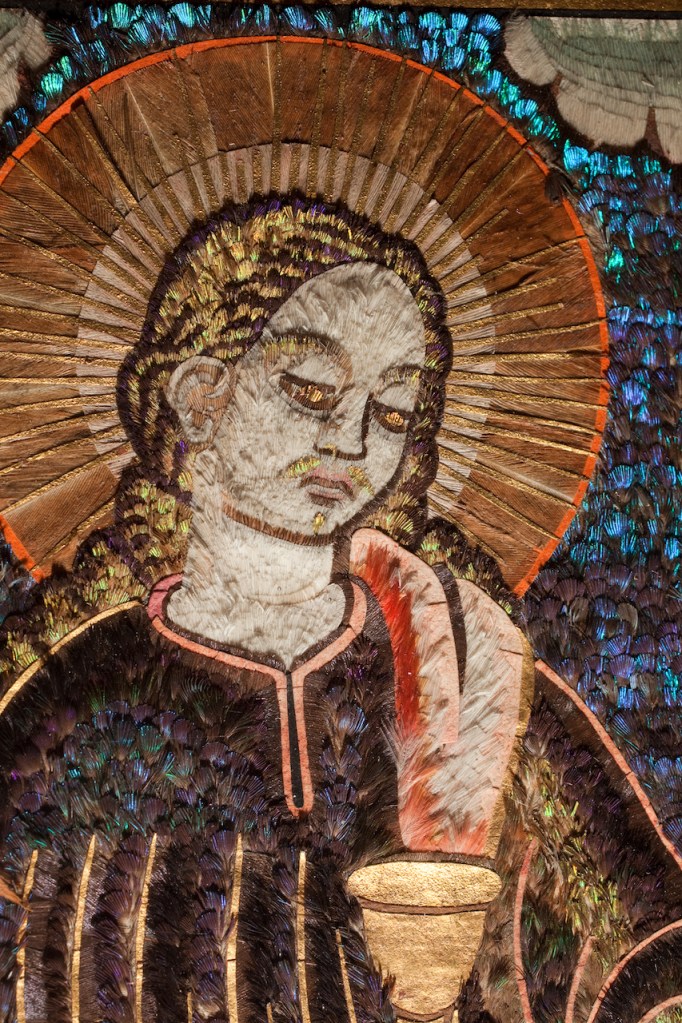
Saint John the Evangelist,
New Spain, 17th century
Feather mosaic and paper on copper
Collection of Daniel Liebsohn
 Henry Xie